

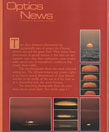
November, 1988 Issue
Feature Articles
Beyond the (visible) rainbow
Another, professional, interest in which I have invested a considerable amount of energy over the past three decades is the understanding of the structure of molecules that become attached (adsorbed) to the surface of a solid material. This understanding is important for such a diverse assortment of phenomena as the functioning of catalysts, the electrical properties of small integrated circuits, the separation of ores, and the processes that take place within a fusion reactor. It might seem that this interest would have nothing to do with rainbows, but not so.
by Robert GreenlerTech transfer opportunities for optics
With the August signing of the Omnibus Trade and Competitiveness Act, the National Bureau of Standards disappeared from the federal lexicon, to be renamed the National Institute of Standards and Technology (NIST). The new name reflects a new mandate—helping U.S. industry become more competitive internationally by aiding in technology transfer—and offers some new opportunities for the optics industry.
by Robert E. ParksAt sunset
Two often dramatic phenomena are occasionally seen at sunset: the Chinese-lantern sun and the green flash. What makes these phenomena of special interest is that they are not regularly seen; thus their explanation must involve some special sets of atmospheric conditions that render them visible.
by B. Meinel and Marjorie P. Meinel![An experimental scheme demonstrated by researchers at Princeton and Yale universities, USA, can convert physical noise into errors that can be corrected more easily. [F. Wojciechowski, Princeton University]](jpg/202406-cover-web51fb.jpg)
![A multiplexed image of a human tonsil acquired. [NIAID] using the iterative bleaching extends multiplexity (IBEX) method.](jpg/202404-cover-web51fb.jpg)